International Baccalaureate (IB)
Primary Years Programmes
The IB Primary Years Programme (PYP) serves students aged 3 to 12 by fostering their intellectual, social, and emotional development, preparing them to be responsible and active lifelong learners.
What is the IB Primary Years Programme (PYP) Model?
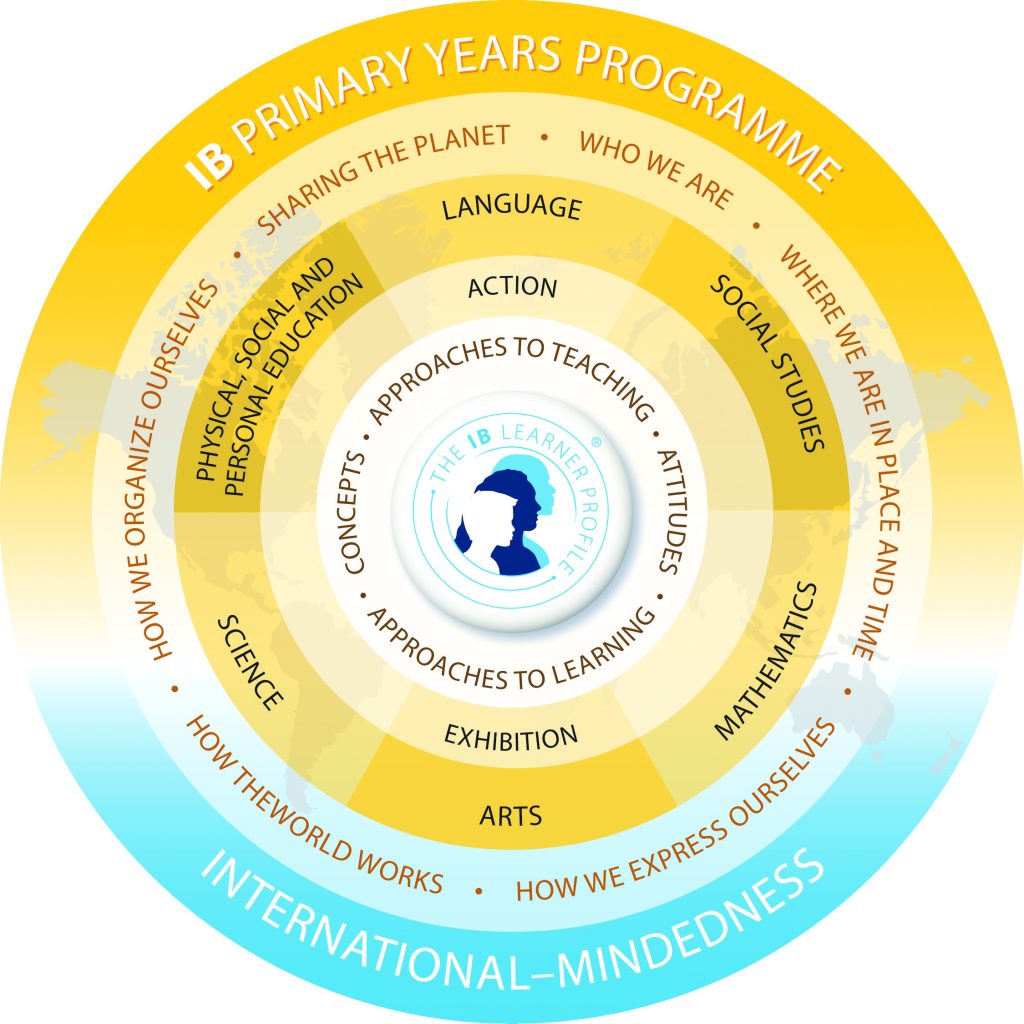
The PYP curriculum offers a learner-focused educational framework for children aged 3 to 12. It is built on the belief that students play an active role in shaping their own learning and work collaboratively as partners in the learning journey. Strong relationships are placed at the heart of the programme to create a supportive and connected learning community.
PYP learners are encouraged to show initiative, take responsibility, and develop a sense of ownership over their learning. Through inquiry-based learning and thoughtful reflection, students build knowledge, deepen conceptual understanding, develop essential skills, and embody the attributes of the IB learner profile—empowering them to positively impact their own lives, their communities, and the wider world.
- The Learner (centre)
At the heart of the PYP is the child as an active, curious learner. Students build understanding through inquiry, reflection, and meaningful action in real-life contexts. - Approaches to Learning (ATL)
ATL are the skills students use to learn effectively—thinking, communication, social, self-management, and research skills. These help students become independent, confident learners across all subjects. - Learner Profile
The IB Learner Profile describes the qualities we develop in students, such as being caring, principled, open-minded, and reflective. - Transdisciplinary Themes & Key Concepts
Learning is organised around broad themes that connect subjects and make learning meaningful beyond the classroom.
The IB learner profile in the PYP
The IB learner profile represents a broad range of human dispositions, capacities and traits that encompass intellectual, personal, emotional and social growth. Developing and demonstrating the attributes of the learner profile is an expression of what the IB means by international-mindedness. The IB learner profile permeates all facets of school life in the PYP. All members of the learning community—from the youngest learners to school leaders to parents, educators and beyond—have a responsibility to be guided by and demonstrate a commitment to the development of the IB learner profile attributes.
Informed by the values described in the learner profile, an IB education:
- Focuses on learners—the IB’s student-centred programmes promote healthy relationships, ethical responsibility and personal challenge
- Develops effective approaches to learning and teaching—IB programmes help students to develop the knowledge, dispositions and skills needed for both academic and personal success
- Works within global contexts—IB programmes increase understanding of languages and cultures, and explore globally significant ideas and issues
- Explores significant content—IB programmes offer a curriculum that is broad and balanced, conceptual and connected
The PYP is designed to focus on the development of the whole child as an inquirer, both in the classroom and in the world outside. It is a framework guided by six transdisciplinary themes of global significance, explored using knowledge and skills derived from six subject areas, as well as approaches to learning (ATL) skills. The PYP is flexible enough to accommodate the demands of most national or local curriculums and provides the best preparation for students to engage in the IB Middle Years Programme (MYP).
IB Transdisciplinary Themes
- Who we are
Inquiry into the nature of the self; beliefs and values; person, physical,
mental, social and spiritual health; human relationships including
families, friends, communities and cultures; rights and responsibilities;
what it means to be human. - Where we are in place and time
Inquiry into orientation in place and time; personal histories; homes
and journeys; the discoveries, explorations and migrations of
humankind; the relationship between and the interconnectedness of
individuals and civilizations, from local and global perspectives. - How we express ourselves
Inquiry into the ways in which we discover and express ideas, feelings,
nature, culture, beliefs and values; the ways in which we reflect on,
extend and enjoy our creativity; our appreciation of the aesthetic. - How the world works
Inquiry into the natural world and its laws, the interaction between
the natural world (physical and biological) and human societies;
how humans use their understanding of scientific principles; the
impact of scientific and technological advances on society and on the
environment.
- How we organize ourselves
Inquiry into the interconnectedness of human-made systems and communities; the structure and function of organizations; societal decision-making; economic activities and their impact on humankind and the environment. - Sharing the planet
Inquiry into rights and responsibilities in the struggle to share finite resources with other people and other living things; communities and the relationship within and between them; access to equal opportunities; peace and conflict resolution.
Each theme is addressed each year by all students. (Students aged 3 to
6 engage with four of the themes each year.) These transdisciplinary
themes help teachers to develop a programme of inquiries—
investigations into important ideas, identified by the schools, and
requiring a high level of involvement on the part of the students.
Since these ideas relate to the world beyond the school, students see
their relevance and connect with it in an engaging and challenging way.
Students who learn in this way understand their roles and responsibilities
in the learning process.
PYP students know that a unit of inquiry involves in-depth exploration of
an important idea. They partner with teachers to document and collect
evidence of how well they understand that idea. They will expect to be
able to work in a variety of ways, on their own and in groups, to allow
them to learn to their best advantage.
Model inquiry and
continually inquire
into their teaching
practices and learning
processes of students as
a source of professional
development
Support thinking and
metacognition (thinking
about thinking) with
prompts and tools
Implements hands-on
learning, recognizing that
a child’s hands, eyes and
ears are infinite sources of
discovery
Scaffold connected
opportunities for
development of skills
Create flexible and
engaging learning
spaces and promote
independence and
collaboration
Provide time for learners
to wonder, explore, build
and revise theories,
engage in research and
reflect on learning
Value students as
capable inquirers
Are open-minded about
the process of inquiry,
using conceptual
understandings to
anchor sustained
investigations
Extend learning with
open-ended questions or
problems
Use prior knowledge
as launching point for
new learning
Engage curiosity through
meaningful learning
engagements to launch
and re-launch conceptual
investigations
Use real world contexts
and primary experiences
as significant activators
of learning
Learning and teaching
through inquiry
Personalise learning by
employing a range of
strategies and flexible
groupings
Understand the
importance of
collaborative learning
and value the
contributions of both
individuals and groups
Reserve whole-class
experiences for
meaningful instructional,
collaborative and
reflective moments
Support students
to make deliberate
connections within and
between subjects
Consider materials,
fieldtrips, learning
engagements as stimuli
for inquiry
Generate routines,
questions, strategies
and systems that can be
transferred across a range
of contexts
Monitor and document
learning providing
meaningful feedback
throughout
Measure the products
of learning against
established success
criteria
The IB mission statement
The International Baccalaureate® aims to develop inquiring, knowledgeable and caring young people who help to create a better and more
peaceful world through intercultural understanding and respect.
To this end the organization works with schools, governments and international organizations to develop challenging programmes of international
education and rigorous assessment.
These programmes encourage students across the world to become active, compassionate and lifelong learners who understand that other people,
with their differences, can also be right.
Roots IVY offers a top-tier education from early years to college, prioritizing quality instruction and independent learning. Committed to pioneering education in Pakistan, it forges diverse partnerships for unique learner paths.
Quick Links
All Rights Reserved ©2025 IVY ACADEMIC NETWORK.
Powered by RIVY

Subscribe Now
Don’t miss our future updates! Get Subscribed Today!
- Contact
All Rights Reserved ©2024 IVY ACADEMIC NETWORK.
🎓 Something Exciting is Coming Soon!
We’re working hard to enhance your academic journey. Stay tuned – a better learning experience is on its way!
At IVY Academic Network, we’re dedicated to empowering students, educators, and institutions with top-tier academic solutions. Our new platform is launching soon to serve you even better.
Contact Us